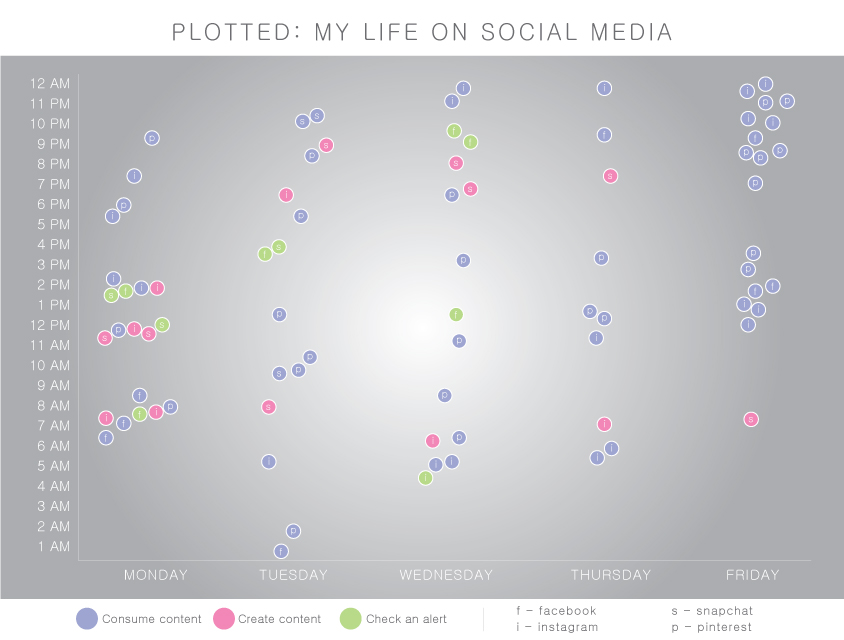
Wow. What a journey. This week has been eye opening to say the least. I gave up my social media favorites this past week: Facebook, Instagram, Pinterest and Snapchat. Then, I conducted a little personal data collection experiment: How many times throughout the day would I think about either consuming or creating content on social media and how many times would I go to check an alert? The results were astonishing, and I’ve been able to draw some significant conclusions from the exercise. Before I go into those conclusions, here is a little detail about how I conducted my data collection:
- I moved my social media apps to the back of my phone.
- Any time I thought about going on social media to post or consume content, I noted it with the time in my notepad on my phone. I later transcribed all occurrences into an Excel spreadsheet at the end of each day.
- I captured which social media platform I wanted to use, the exact time of day, and whether I was going on to post, consume or check an alert.
- I also captured some accompanying information not depicted in my final graphic (ex. what I was doing when I wanted to check social media and what exactly I wanted to do).
- I then plotted each time in a graphic to illustrate my 5 day experiment in a meaningful graphic.
- Midway through the week I turned off the alerts as I wanted to see if I stopped thinking about social media as much with the alerts turned off.
- A larger, more readable version of my plotted data can be found here.
1) I have more time than I think I have.
I thought about social media 83 times this week, averaging ~17 times per day. Hypothetically, if I engaged in social media for just 4 minutes each of the 17 times, that totals to just over an hour a day. And let’s face it, there is no way my scrolling is limited to 4 minutes. This was pretty jarring. I complain more than anyone that there isn’t enough time in the day to get done what I need to get done and/or WANT to get done. However, I am wasting an hour of my day getting “Pinspo” on some project that I will probably never do or coveting the photo montage of my high school friend’s trip to Rome. Instead of wasting an hour a day on social media I could be actually working on that Pinterest-inspired project!! Yes, many of those 17 times were probably times where I was multitasking some other less pleasant activity (ex. unnecessary conference call or riding as a passenger in a car). My point being that I could not necessarily quantify the times I thought about social media and then in the future definitively seize that extra time to start that farmhouse dining room table project. Even if we cut the 17 number in half, representing potentially the number of times I engage in social media without multitasking some other activity, that still could be enough time for a nice 30 minute workout, yoga session, relaxing bubble bath or the “me time” I love to complain that I never get.
2) My brain has become very uncomfortable with r e s t.
I seize my phone and turn to social media at every chance I get. Whether it’s waiting at the dentist’s office or waiting for water to boil so I can throw in some pasta, I have my phone accessible and at the ready to save me from the silence of my own brain. What original, insightful, creative ideas am I missing out on by turning my brain “off” to the tune of a scrolling news feed? I am drowning in constant chatter and, while it seems like that would be exhausting and uncomfortable, I can’t shy away from it. According to a CNN.com article, Smartphone Addiction Could Be Changing Your Brain, “cell phone
addiction is on the rise, surveys show, and a new study released Thursday adds to a growing body of evidence that smartphone and internet addiction is harming our minds — literally.” The article expands to describe an experiment conducted at Korea University in Seoul that compared the brain scans of 19 “internet/smartphone addicted” teenage boys to 19 teenage boys who were not addicted and found physiological differences between the two groups, including “significantly higher levels of GABA, a neurotransmitter in the cortex that inhibits neurons, than levels of glutamate-glutamine, a neurotransmitter that energizes brain signals” in the group who was addicted. The article suggests that “medium to heavy multitaskers, who engage in multiple forms of media simultaneously, tend to demonstrate matter area in the anterior cingulate cortex, which is the area of the brain responsible for top-down attention control…Altogether this means that if you are too dependent on your smartphone, you are basically damaging your ability to be attentive.”
The scary part is that I can personally feel this happening to me…
3) I don’t live in the present moment.
The world of social media is made up of the “haves” and “have-nots”. It’s very easy to become consumed with the latter and throw your own life into that bucket. The sheer nature of “following” someone on social media, opens yourself up for judging the quality of your own life. Your life becomes altered and soured by the constant nagging reminder that *someone* else’s life is better than yours. Someone else’s kids are sleeping through the night. Someone else has #postpartumrockhardabs. Someone else’s career is moving at a faster pace than yours. You begin to live vicariously through that person or that account and instead of enjoying the moments of your own life in the moment. According to an article by The Atlantic titled, Have Smartphones Destroyed a Generation?, The “rates of teen depression and suicide have skyrocketed since 2011. It’s not an exaggeration to describe iGen as being on the brink of the worst mental-health crisis in decades. Much of this deterioration can be traced to their phones.” The iGen population the article is referring to describes the population of “kids” born between 1995 and 2012.
While conducting my data collection exercise, I read chapter 3 of Cal Newport’s Deep Work titled “Deep Work is Meaningful”. This chapter is the one that has resonated with me the most thus far. He opens the chapter discussing the life’s work of a present-day blacksmith who practices an art of ancient and medieval metalwork. He paint’s a picture of this blacksmith, named Ric Furrer, isolated in his converted barn in Wisconsin farm country. He discusses how precisely Furrer carries out his process and how he handles each piece of art with extraordinary care. The point he is trying to make that the work of a craftsman is meaningful and the execution of that craftsmanship is almost always in deep concentration, attention and focus. Later in the chapter he theorizes that there is a connection between deep work and work that has great meaning. Shallow work, like engaging with social media or answering emails does not allow our human brains to enter a state of any kind of concentration. We are bombarded with attention-grabbing one-liners, video clips and hashtags, and our brains are completely unfocused. IT DOESN’T FEEL GOOD. It is shallow, meaningless work and I couldn’t agree more with Newport’s statements. He goes on to say, “Human beings, it seems, are at their best when immersed deeply in something challenging.” I love this quote. Social media is entertaining, but after scrolling for 20 – 30 minutes, I can honestly say that I don’t feel accomplished or satisfied. However, give me some old wood pallets, 2x4s, a drill and wood glue and ask me to build a tikki bar (true story), and I am on cloud 9.
So what am I going to do with the conclusions drawn from my exercise? I can tell you one thing, the social media apps are staying at the back of my phone, out of immediate sight. At this point, I don’t think I will ever do completely away with them, especially as a parent who will want to monitor the social media accounts of my kids. The exercise has really gotten me to think about my time and how I want to spend it. I can’t tell you how much highlighter and marginalia appear in Chapter 3 of Cal Newport’s Deep Work book. It really took me back to thinking about my childhood and how I spent my time. Woodworking, crafting, thinking, creating – all of the above occupied my time and I was a truly happy kid with a genuine love for hard work. I want to feel more of this and cultivate time in my schedule to work with my hands more. On the flip side and equally as important, I want to treat my career in Digital Technology as my master craft. I want those on my team to elevate themselves from the daily shallow work world of email and engage in meaningful activities and problem-solving. Newport believes that we can apply the same principles that apply to the world of craftsmen to the world of knowledge work. After reading Chapter 3, I am already a believer.

 The Corporate Mom Blog